
Why Are So Many Physiotherapists Using Clinical Pilates in Toronto?
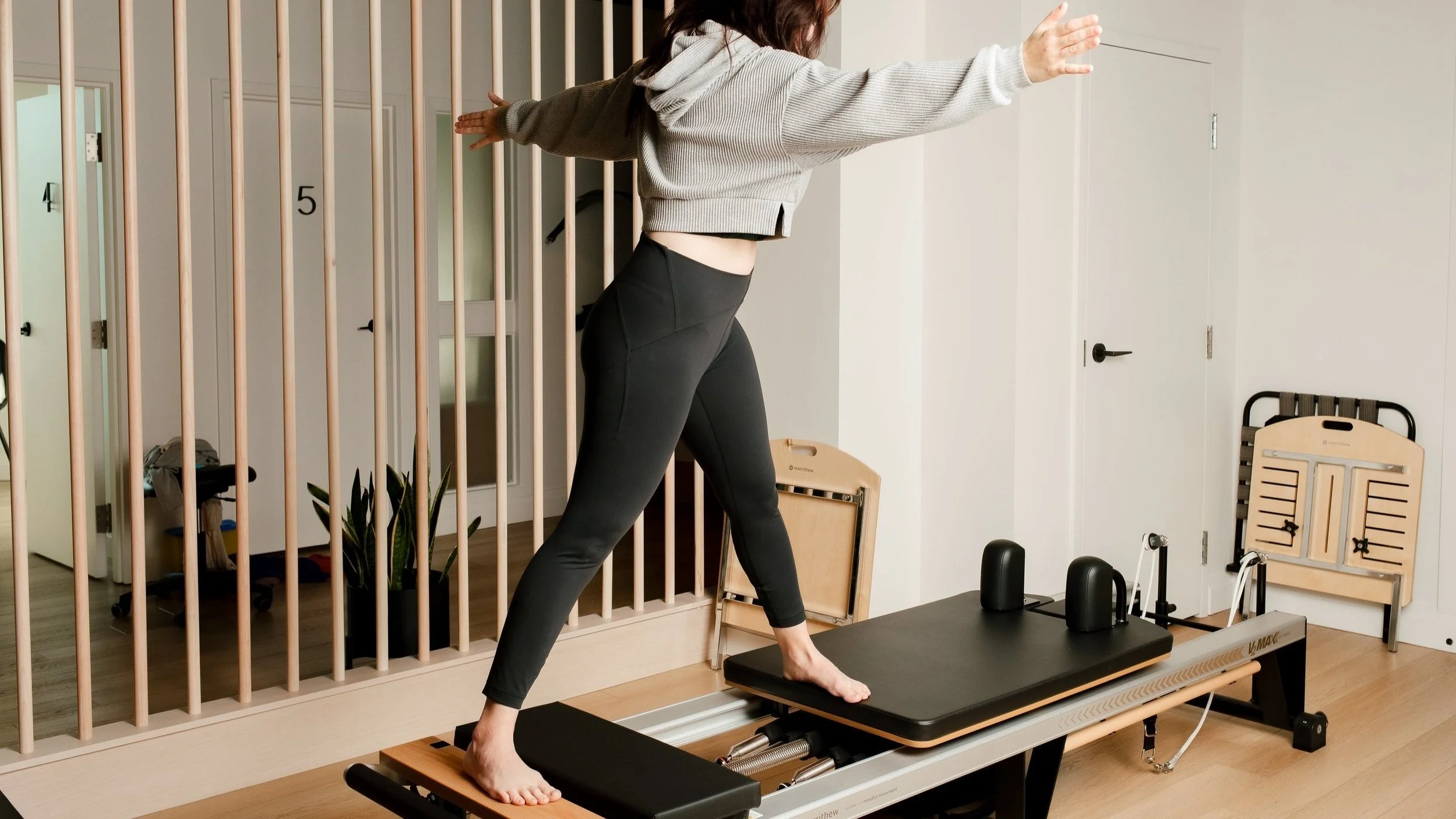
You may have noticed more physiotherapists incorporating Clinical Pilates in into their treatment plans.
I believe Clinical Pilates can be an incredibly valuable component of physiotherapy treatment.
It can help you slow down, understand how your body is moving, build body awareness, and gradually develop more confidence in what your body can do.
For me, this isn't just something I learned in a course. I came to Pilates through my own experience with pain.
The Bridge Between Pilates & Physiotherapy
How I Found Pilates
I was dealing with several areas of pain following sports, including ongoing right shoulder rotator cuff issues and chronic exertional compartment syndrome.
At the time, I was very into strength training and working out. But there was a problem. I often felt worse after exercising. I would flare up, feel like I had taken a step backwards, and need to back off again. I tried decreasing my reps and decreasing the load.
I also worked with some wonderful practitioners who used acupuncture and manual therapy, and these modalities were helpful. But whenever I tried to increase my activity again, I would sometimes have another setback.
Eventually, I sought support from a personal trainer who incorporated a lot of Pilates and movement mechanics into our sessions.
Something changed.
We slowed things down. I started paying much more attention to where I was feeling a movement, how I was moving, and when my form started to change.
Instead of simply asking, “How much weight can I lift?” I started asking, “How well can I do this movement?” and “How many repetitions can I do before my body starts compensating?”
I was learning my tolerance point.
That experience completely changed the way I thought about movement and ultimately shaped how I practice physiotherapy today.
So, Why Clinical Pilates?
1. It teaches you how to move
One of the biggest benefits of Clinical Pilates is movement education. We often perform exercises without really thinking about where a movement is coming from.
Take a simple bridge. Are you lifting primarily from your hips and glutes? Or are you creating most of the movement through your lower back?
There isn't necessarily one perfect way to move. The goal is to develop more options, more awareness and more purpose behind your movement. Clinical Pilates gives us the opportunity to slow down enough to actually notice these details.
2. It increases body awareness
This might be one of my favourite parts.
Clinical Pilates encourages you to turn your attention inward. What muscles do you feel working? Where are you holding tension? What happens when you change your foot position? Can you feel your ribs moving as you breathe?
And perhaps most importantly, does the movement feel different when you change the way you are doing it?
You aren't just being told how to perform an exercise. You are learning how to feel your own movement. The more you notice, the more information you have to work with.
3. It gives you a language for movement
There is a quote often attributed to Ludwig Wittgenstein:
“The limits of my language mean the limits of my world.”
I think there is something similar happening with movement.
The more language you have for your body, the better you can understand, respond to and be cued through movement. If someone says “retract your shoulder blade,” “tilt your pelvis,” or “find your hip,” do you know what that feels like in your body? Do you know where it is?
Understanding basic anatomy and movement terminology can give you a greater ability to communicate with your own body.
You become an active participant in your movement rather than simply following instructions.
4. It can be a great foundation for ELDOA
Clinical Pilates can also provide a useful foundation for other movement practices, including ELDOA.
The slower, more precise movement skills developed through Clinical Pilates can help you become more comfortable with this type of detailed movement practice, particularly when working on spinal and joint positioning.
5. It can help rebuild trust in your body
When you've been dealing with pain or repeated flare-ups, it is understandable to become cautious around movement. You might start wondering, “Is this going to hurt?” “Am I going to flare up again?” or “Can I actually do this?”
Sometimes returning to the foundations can be incredibly helpful. Rather than jumping straight back into the activity that previously caused problems, we can start with smaller, more controlled movements.
You learn what feels good. You learn what feels challenging. You learn your current tolerance, and then you gradually build from there.
That process can help rebuild confidence and trust in your body.
6. It can provide a foundation for strength training
I don't see Clinical Pilates and strength training as opposing approaches. Quite the opposite. I think Clinical Pilates can be a wonderful foundation for strength training.
Before adding more load, it can be helpful to understand the movement itself. Can you control the position? Can you breathe? Can you feel the muscles you are trying to use? Can you maintain the quality of the movement as you fatigue?
And importantly, how much can you currently tolerate well?
Once you understand these things, you have more information to work with when progressing your strength training.
How Does Clinical Pilates Fit Into Physiotherapy?
This is where I think the combination gets really interesting.
Physiotherapy can include many different tools: manual therapy, acupuncture, exercise, education, mobility work, strength training, movement retraining and Clinical Pilates. These approaches don't have to exist separately.
Sometimes hands-on treatment can help reduce symptoms or make movement feel more accessible. But we also need to ask: what happens when you start moving again?
If a movement pattern is contributing to your symptoms, exploring that movement can be an important part of physiotherapy. This doesn't mean there is one “correct” way to move. There isn't. Bodies are adaptable, and there are often many ways to perform the same movement.
You might notice that you create a lot of movement through your lower back when hinging, feel tension at the top of your shoulder during rows, or rely heavily on the outside of your foot when walking. We can slow these movements down, explore what's happening, and experiment with different strategies to see what feels more supportive.
These aren't about finding one perfect position.
They're about giving your body more choices and having a purpose behind the movement.
Your Physiotherapy Should Teach You Something
For me, physiotherapy isn't just about getting you out of pain so you can go back to doing the same things as before.
It's also about helping you understand your body. What are you feeling? What changes your symptoms? What movements feel good? What movements are challenging? What is your current tolerance?
And perhaps most importantly, how can you learn to recognize these things yourself?
Because ultimately, I don't want you to need me every time something feels a little off. I want you to leave with a better understanding of your own body and a greater sense of confidence in your ability to work with it.
Clinical Pilates & Physiotherapy in Toronto
At Terra 244 Physiotherapy, in the Dufferin and St. Clair West area of Toronto, Clinical Pilates is incorporated into physiotherapy as part of a broader movement-based approach.
Whether you're returning to exercise after an injury, dealing with persistent pain, wanting to better understand your movement mechanics, or simply hoping to feel more connected to your body, Clinical Pilates can be one tool within your physiotherapy care.
If you're looking for Clinical Pilates in Toronto or physiotherapy near Dufferin and St. Clair, I would love for you to come explore what movement can feel like when we slow it down, pay attention, and work with your body rather than against it.